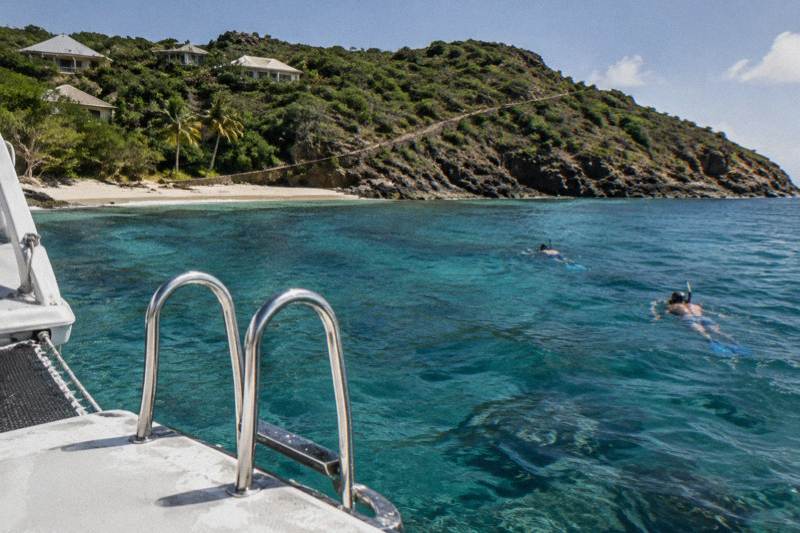
Where To Snorkel In St Barts: Shore Entries, Boat Stops And Reserve Rules
Snorkeling in St Barts splits into two worlds: a handful of shore entries and a set of reserve-protected bays that almost everyone reaches by boat. Here is what the listings, the reserve rules and the climate record actually say.
Short answer
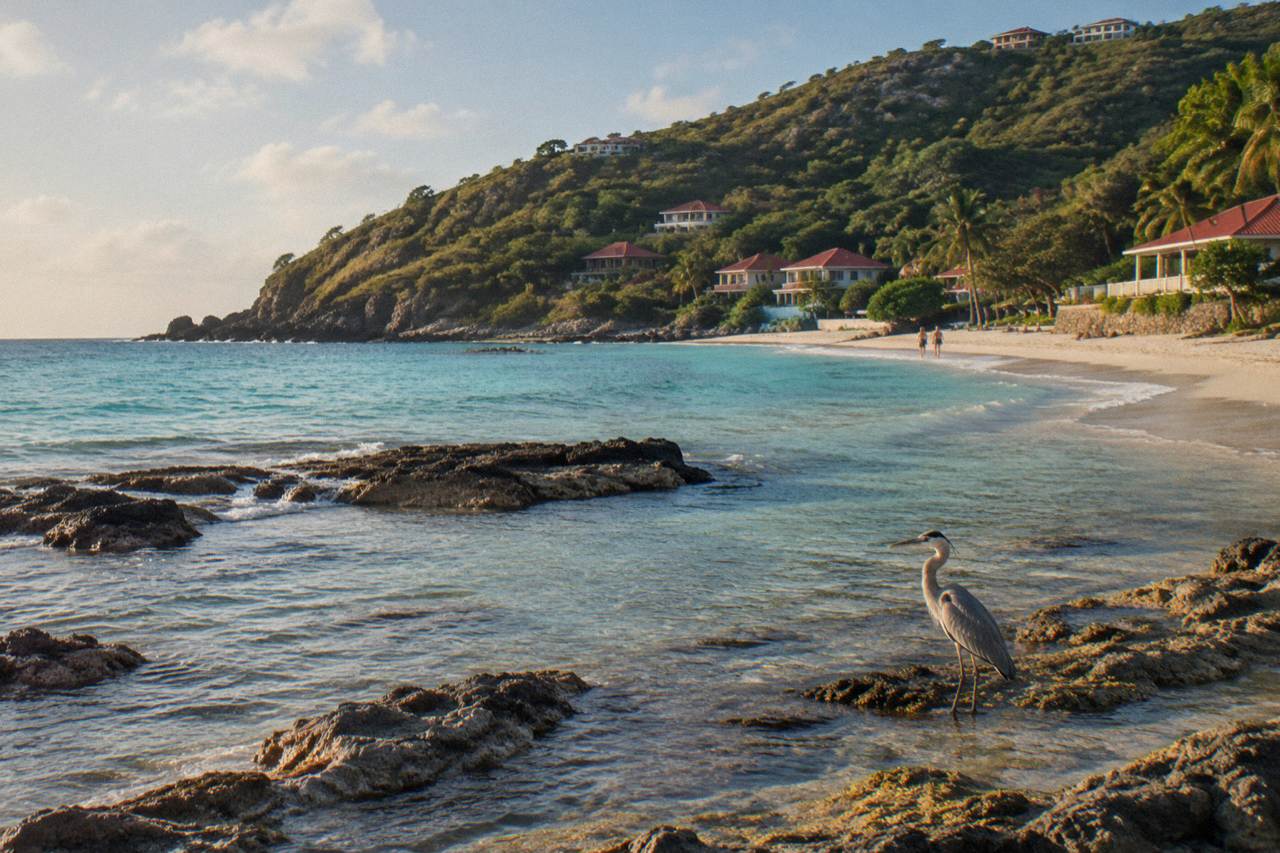
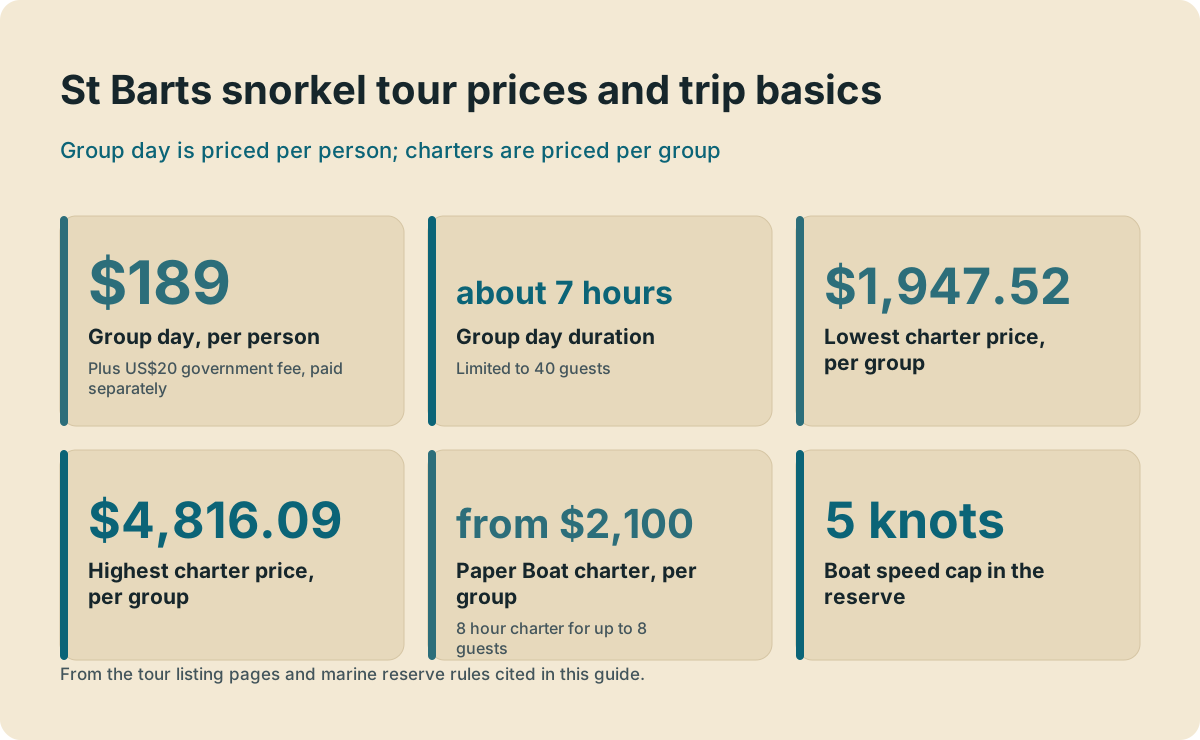
The named snorkel stops on the island's tours are Colombier Beach, Ile Fourchue, St Jean Beach and Gustavia's harbour waters. The only per-person boat day costs from $189 plus a US$20 government fee and runs 12 May to 31 August 2027. Five private charters, from $1,947.52 per boat, are priced for your whole group rather than per guest.
Snorkeling in St Barts is shaped less by marketing and more by geography and law. The island sits inside a marine reserve that caps boat speed at 5 knots, bans jet skis outright and forbids touching coral or turtles, and several of its best-known snorkel bays have no road access at all. That is why the tour roster here is what it is: one per-person group boat day out of Simpson Bay, Sint Maarten, and five private charters departing from St Martin marinas. Nothing else exists to book.
The named stops on those listings are specific. The group day run by Boomerang Boat Charters lists Gustavia, Colombier Beach and Ile Fourchue. The full-day Anse Marcel charter lists St Jean Beach and Gustavia. Everything else this guide covers comes from the reserve authority's own published rules and the Meteo-France climate record for the island's weather station, so you can plan around what is actually written down rather than around promises.
Which St Barts Snorkel Stops Can You Reach From Shore?
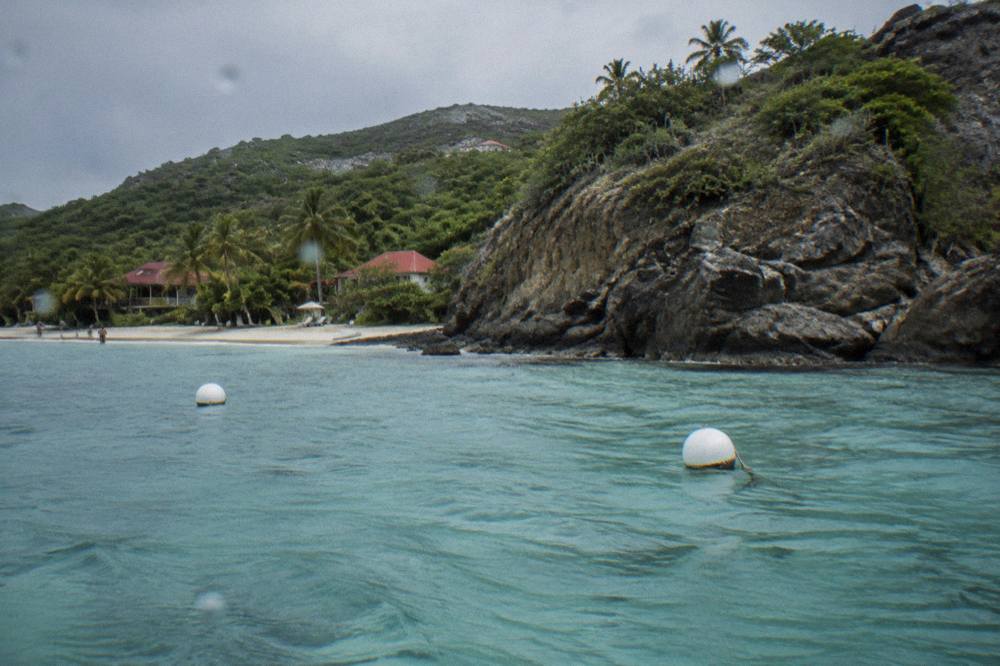
Shore snorkeling in St Barts exists, but the headline bays the tours advertise, Colombier Beach and Ile Fourchue, are not practical shore entries: Colombier sits at the end of a hiking trail and Fourchue is an offshore island. The listings name St Jean Beach and Gustavia as their in-town stops, and those are the shore-accessible options this site's roster actually documents. Anything beyond them is outside what the listings state.
Start with what the tours themselves say, because the tour pages are the only product-level descriptions verified for this site. The Boomerang group day from Simpson Bay, about seven hours long and limited to 40 guests, lists Gustavia and Colombier Beach as its St Barts anchors. The Love Boat Sxm full-day private charter out of Anse Marcel lists St Jean Beach and Gustavia. Those four names are the documented snorkel geography of this roster, and the pattern is telling: even operators selling full-day trips concentrate on Gustavia, St Jean, Colombier and Fourchue rather than scattering across a dozen coves.
For a shore-based visitor staying on the island, that leaves St Jean and the Gustavia area as the entries the listings themselves treat as town-adjacent swim stops. St Jean is the beach framed by the Eden Rock headland on the island's north shore; Gustavia's harbour waters are the charter's second listed stop. What conditions you find on any given morning is exactly what sea state decides, which this guide covers in its own section below. No listing promises visibility, water temperature or sightings, and this site does not either.
| Stop | How the roster reaches it | Shore access | Which listing names it |
|---|---|---|---|
| Gustavia | Group day and full-day charter both stop here | Yes, in town | Boomerang group day; Love Boat Sxm charter |
| St Jean Beach | Full-day private charter stop | Yes, public beach | Love Boat Sxm charter |
| Colombier Beach | Group day stop | Trail access only, no road | Boomerang group day |
| Ile Fourchue | Group day stop | No, offshore island | Boomerang group day |
A note on expectations: this site's inventory is deliberately small, and it does not pretend otherwise. There is no shore-snorkel product, no kayak tour, no dive boat and no jet ski rental anywhere on the roster, and the reserve bans jet skis, seabobs and electric surfboards in its waters regardless of who sells what. If a shore morning at St Jean is your plan, the practical pairing is a boat day for the bays you cannot walk to. For a wider look at the island's swimmable coastline, see the companion piece on the best beaches in St Barts.
Which St Barts Snorkel Bays Are Only Reachable By Boat?
Colombier Beach and Ile Fourchue are the boat-dependent stops on this roster, and both sit inside the marine reserve's protected zones. Colombier has no road, only a trail, and Fourchue is an offshore island northwest of St Barts. The reserve caps boats at 5 knots in these waters and runs ecological mooring buoys in both bays, which is why every product that visits them is a sail or motor charter rather than a fast craft.
Colombier is the name that recurs across everything written about snorkeling here, and for a structural reason: the bay is one of the reserve's five zones, sheltered, trail-only and buoyed. The reserve authority's published rules state that 40 ecological mooring buoys serve Colombier and Fourchue between them, advised for vessels up to 20 tonnes and 25 metres, with stays of 96 consecutive hours. Boats over 25 metres are not authorised in either bay at all. A snorkeler floating off Colombier is, in other words, inside a managed zone with an anchoring plan, not a random cove.
Ile Fourchue is the second stop reached by boat, an island anchorage the group day lists by name alongside Colombier, which sits at the end of a hiking trail, and Gustavia. The reserve treats Fourchue's bay under the same simple-protection rules as Colombier: no taking coral, plants, shells or crustaceans, no gloves in the water, no dogs on the beaches, no feeding animals and no dumping. Touching a protected marine species, a turtle or coral among them, is banned. None of this is fine print; it is the operating environment of every boat on this roster.
The cheapest documented route to both bays is the group day: from $189 per person plus a government fee of US$20 paid separately, about seven hours, max 40 guests, with lunch, alcoholic beverages, snorkelling equipment, paddle boards, life jackets in adult and child sizes, floating noodles and a lily pad listed as included. It runs 12 May to 31 August 2027 only. The listing shows 8 reviews at 5.0, a pool too small to treat as a rating claim. Outside that window, the only way to these bays on this roster is a private charter.
If you are weighing the group day against a charter, the arithmetic is worth doing once. Five of the six listings are private charters priced per group between $1,947.52 and $4,816.09. Split across the stated group maximum, the same boats can work out to a per-guest figure in the neighbourhood of the group day price, but that is plain arithmetic on the stated maximums, not a discount claim; with two guests on a charter the per-person figure is several times higher. The trade is exclusivity and date freedom against the $189 headline.
What Do The Marine Reserve Rules Mean For Snorkeling In St Barts?
The reserve's rules translate to five practical points for a snorkeler: swim without gloves, never touch coral or turtles, take nothing, feed nothing, and expect boats to move at 5 knots or less. The reserve also marks 23 dive sites with a red square crossed by a white diagonal, zones where only ecological buoys may be used and fishing and anchoring are barred. These are published regulations, not etiquette suggestions.
The five zones of the Reserve Naturelle include the bays of Colombier and Fourchue, the islets of Gros Ilets, Pain de Sucre, Toc Vers and Frégate, and the Grand Cul-de-Sac area with Ilet Tortue and the Grenadins, per the reserve authority's published zone descriptions. Within simple-protection zones such as Colombier and Fourchue, the bans cover collecting coral, plants, shellfish and crustaceans, dumping garbage, feeding animals, dogs on beaches and noise pollution, plus gloves in the water and touching protected species. Reinforced zones add a total ban on fishing, anchoring and scuba diving.
The 23 marked dive sites, each flagged by a red square with a white diagonal, follow their own stricter set: ecological buoys only, boats up to 10 tonnes and 15 metres, one boat per buoy, and visits capped at 2 hours 30 minutes, with no sailboats, no gloves and no fishing gear aboard. A snorkeler on a charter is unlikely to need this level of detail, but the skipper will, and it explains why boats behave the way they do inside the reserve: slow, buoyed and careful. The full zoning text is published by the French environment agency's reserve pages.
| Reserve rule | What it means in the water |
|---|---|
| 5 knot speed limit | Boats approach swim stops slowly; expect a calm arrival |
| No touching protected species | Look, do not touch turtles or coral, in every zone |
| No gloves | Snorkel bare-handed, even near rocks |
| No taking coral, plants, shells, crustaceans | Nothing leaves the water with you |
| Jet skis and propulsion devices banned | No jet ski product exists here, by law |
| 40 ecological buoys in Colombier and Fourchue | Boats moor rather than anchor in the bays |
One further zone rule deserves a plain sentence: in the Grand Cul-de-Sac lagoon the reserve publishes specifics of its own, including a 50 metre strip where kitesurfing is forbidden, snorkeling-only areas with protected corals, a 3 knot channel limit and catch-and-release fishing conditions. Grand Cul-de-Sac is not on any of this site's tour listings, so it is a shore or independent-trip consideration rather than something a roster boat visits. For the full regulatory picture, the marine reserve explained article walks through the zones in more depth.
The Paper Boat Charter, an 8 hour private charter for up to 8 guests from Marina Anse-Marcel at from $2,100 per group, is the roster's mid-sized motor option and the only listing here rated 5.0 across 17 reviews, a pool just large enough to quote. Its inclusions run to a fuel surcharge, unlimited beer, wine and soft drinks, a professional guide, snorkelling equipment and a giant floating mat. Which bays it visits is a conversation with the operator; what is fixed is that inside the reserve it operates under every rule in the table above.
Which Boat Tour Reaches Which Snorkel Stop From St Martin?
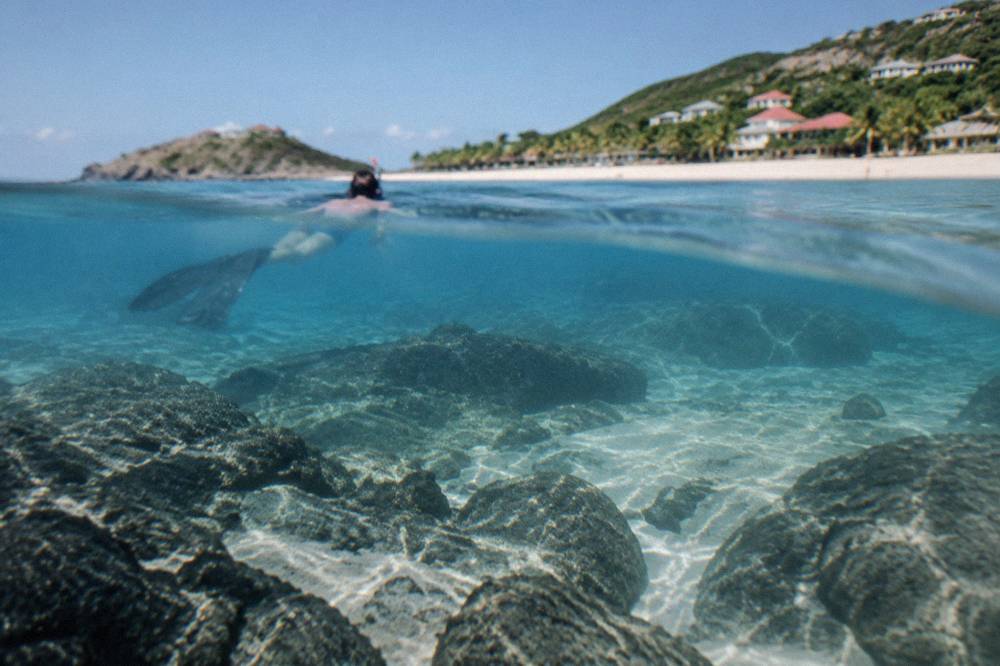
Every snorkel-relevant product on this roster departs from St Martin or Sint Maarten, not from St Barts itself. The Boomerang group day leaves the Dinghy Dock Bar in Simpson Bay; the Love Boat Sxm charter leaves Marina de l'Anse Marcel; Paper Boat runs from Anse-Marcel; Seven Marine from Cole Bay; the Zephyr catamaran from Grand Case. None is an on-island St Barts tour.
This matters more than it first appears. A visitor staying on St Barts cannot board any of these six products at Gustavia; they are crossings with snorkel stops, designed around a St Martin base. The Boomerang group day is the per-person option, about 7 hours, from $189 per person plus the US$20 government fee, meeting at the Dinghy Dock Bar in Simpson Bay, Sint Maarten, with lunch, drinks, snorkelling gear, paddle boards, life jackets, noodles and a lily pad listed. Its operating window is 12 May to 31 August 2027 and it carries free cancellation on the listing.
The five charters are year-round by contrast, priced per group. Love Boat Sxm's full day, about 8 hours and up to 10 guests from $1,947.52 per group, lists stops at St Jean Beach and Gustavia, with soda, snorkelling gear, fuel, a paddle board and a floating mat included and dock fees at St Barthelemy excluded at 40 EUR per boat plus 5 EUR per guest. Seven Marine's Nikki Beach trip, 6 to 8 hours and up to 15 guests from $2,120 per group, adds round-trip private transfer, an open bar and snacks, excluding gratuities and customs clearance fees. Zephyr's overnight catamaran, from $4,816.09 per group for up to 4 guests over 2 days, includes breakfast, lunch and dinner but not lunch in Gustavia or crew tips of 15 to 20 percent.
| Product | Departs | Group size | Price (FIRM) | Duration |
|---|---|---|---|---|
| Boomerang group day | Dinghy Dock Bar, Simpson Bay | Max 15 | From $189 per person plus US$20 fee | About 7 hours |
| Love Boat Sxm charter | Marina de l'Anse Marcel | Up to 10 | From $1,947.52 per group | About 8 hours |
| Paper Boat motor charter | Marina Anse-Marcel | Up to 8 | From $2,100 per group | About 8 hours |
| Paper Boat sailboat charter | Saint Martin | Up to 8 | From $2,000 per group | 7.5 hours |
| Nikki Beach charter | Cole Bay, Sint Maarten | Up to 15 | From $2,120 per group | 6 to 8 hours |
| Zephyr overnight catamaran | Quai 58 pontoon, Grand Case | Up to 4 | From $4,816.09 per group | 2 days |
The Paper Boat operation runs two distinct listings and they should not be blurred together: the 8 hour motor charter above, and a separate 7.5 hour private sailboat charter to St Barth, up to 8 guests at from $2,000 per group, with an open bar and snacks listed, free cancellation up to 24 hours before, and as a new listing, no reviews yet. The sailboat is the quieter, cheaper, less-reviewed sibling. Deciding between the two formats, rather than between operators, is usually the real question, and the private charter comparison guide lays the differences out stop by stop.
The full-day Anse Marcel charter deserves its solo mention because it is the only listing that names St Jean Beach as a stop, which makes it the roster's beach-plus-harbour day rather than a reserve-bay day. Its 3 reviews at 5.0 are too few for a rating claim. If St Jean's shore snorkeling is what drew you to this guide, this is the boat that pairs it with Gustavia in one about-8-hour run, and its free cancellation is listed.
How Does Sea State Decide Your Snorkeling Day From St Martin To St Barts?
Sea state, not schedule, is the honest variable in every St Barts snorkel plan: the listings make no visibility, temperature or sighting promises, and this site makes none either. What is documented is climate: monthly rainfall runs from 38.4 mm in February to 135.6 mm in October, and hurricane season spans 1 June to 30 November with a peak from mid-August to mid-October. Skippers, not brochures, judge the water.
The crossing itself is the part first-timers underestimate, and the honest answer to how lumpy it gets lives in a dedicated piece on how rough the sea is between St Martin and St Barts. What can be stated here as fact is climatology from the island's own Meteo-France station, using its 1991 to 2020 normals: average monthly highs run from 28.5 C in January to 31.7 C in September, and monthly rainfall follows the pattern in the table below. Air warmth is close to constant; rain and swell are not.
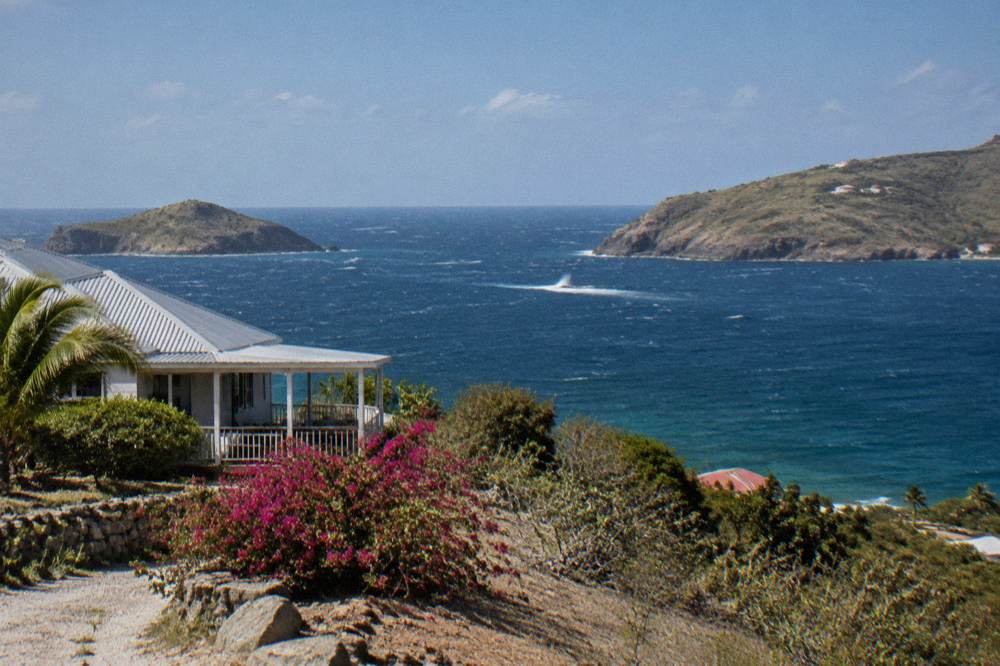
Hurricane season is the structural fact that overlaps the group day's window. The Atlantic season officially runs 1 June to 30 November, with peak activity from mid-August to mid-October, per the US National Hurricane Center's published climatology. The Boomerang group day runs 12 May to 31 August 2027, so its season opens in the dry late spring and runs into the season's first two months; that overlap is a fact of the calendar, not a weather prediction. Charters, which run year-round, simply reschedule when the skipper calls it.
| Month | Avg high (C) | Avg low (C) | Rainfall (mm) |
|---|---|---|---|
| January | 28.5 | 23.5 | 52.6 |
| February | 28.6 | 23.3 | 38.4 |
| March | 29.0 | 23.5 | 41.4 |
| April | 29.8 | 24.2 | 50.9 |
| May | 30.7 | 25.1 | 61.7 |
| June | 31.2 | 25.9 | 56.0 |
| July | 31.2 | 26.0 | 80.4 |
| August | 31.6 | 26.3 | 79.6 |
| September | 31.7 | 26.2 | 96.9 |
| October | 31.4 | 25.8 | 135.6 |
| November | 29.9 | 25.0 | 118.6 |
| December | 28.9 | 24.1 | 79.2 |
Read the table as ranges, not forecasts. The drier stretch sits from January through April, when monthly rainfall stays between the February low of 38.4 mm and April's 50.9 mm; the wettest months are October, November and September in that order. For snorkeling specifically, rain matters less than swell and wind around the anchorages, and no listing or official source publishes visibility figures for these bays, which is exactly why this guide refuses to invent them. A more detailed month-by-month treatment, including what it means for trip timing overall, is in the best time to visit St Barts guide.
Practically, the reserve's sheltered geography works in a snorkeler's favour. Colombier and Fourchue are bays, not open coast, and the 5 knot speed limit inside the reserve keeps boat traffic gentle at the swim stops. The decision that actually varies week to week is whether the crossing from St Martin is comfortable, and that is a question for the operator on the morning, with the free-cancellation terms on every listing here giving you an exit if the answer is no.
What Should You Bring To Snorkel In St Barts?
Bring a towel, reef-conscious expectations and your passport; the boats supply the rest. Four of the six listings name snorkelling equipment, and the group day adds paddle boards, life jackets in adult and child sizes, floating noodles and a lily pad, plus lunch and drinks. Towels and gratuities are the standard exclusions, and the crossing is international, so documents matter as much as gear.
Start with what is already on the boats. The Boomerang group day lists lunch, alcoholic beverages, snorkelling equipment, paddle boards, life jackets in two sizes, noodles and a lily pad, excluding gratuities and towels. The Love Boat Sxm charter lists soda, snorkelling gear, fuel, a paddle board and a floating mat, excluding the St Barthelemy dock fees of 40 EUR per boat plus 5 EUR per guest and the slide. Paper Boat's motor charter includes a fuel surcharge, unlimited beer, wine and soft drinks, a guide, snorkelling gear and a giant floating mat, excluding lunch and gratuities. The sailboat charter lists an open bar and snacks.
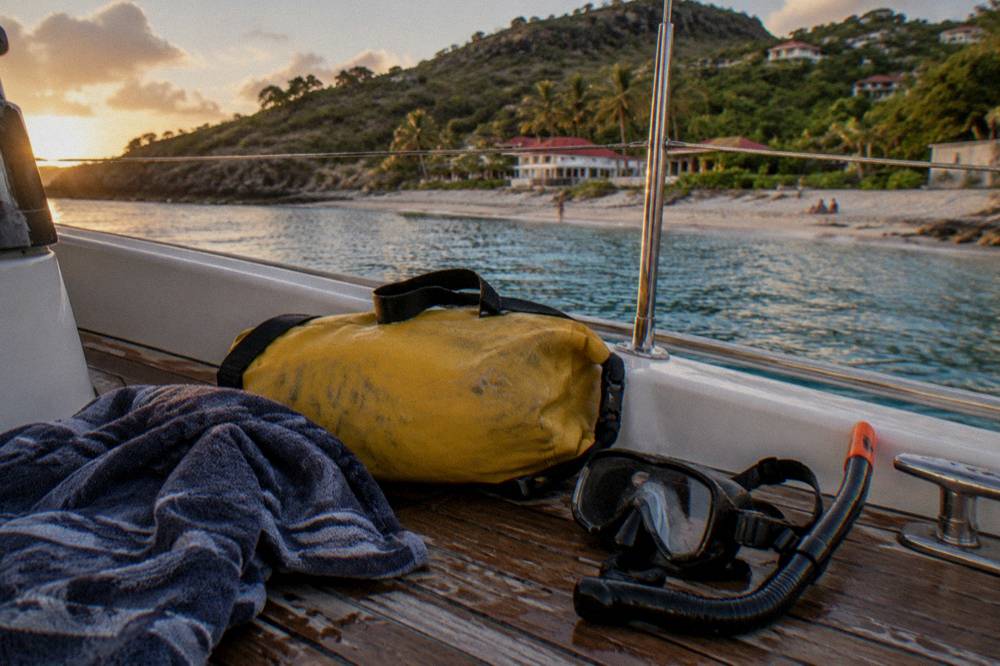
The reserve rules do some of the packing for you. Gloves are banned in the water, so leave yours at home. Nothing may be taken from the water, so skip the mesh collecting bag. If you prefer your own mask and fins over shared gear, that is the one kit decision worth making in advance; fit matters more than brand, and the full packing breakdown, including what to leave on the boat during swim stops, is in what to bring on a St Barts boat tour.
Documents are the item that ends trips. These products depart St Martin or Sint Maarten and land in St Barts, a French territory, so entry rules apply on the water just as at an airport. The verified practical version: Great Bay Express, the ferry operator referenced for context only and not sold on this site, requires a passport for every passenger and closes check-in 15 minutes before departure with a 45 minute arrival window. For entry rules generally, US citizens should check the official US State Department page on the French West Indies before travelling rather than relying on any secondhand summary, including this one.
| Item | Who supplies it | Note |
|---|---|---|
| Snorkelling equipment | Every listing on the roster | Bring your own mask if fit matters to you |
| Life jackets, adult and child sizes | Group day listing | Stated in two sizes |
| Paddle boards, noodles, lily pad | Group day listing | Also on some charters, see each listing |
| Lunch and alcoholic beverages | Group day listing | Charters vary: Paper Boat excludes lunch |
| Towel | You | Excluded on the listings that mention it |
| Passport | You | Required for the international crossing |
| Gratuities | You | 15 to 20 percent customary on the catamaran listing |
Money follows the same logic. Prices on this roster are in USD, from $189 per person on the group day to from $4,816.09 per group on the overnight catamaran, but two listings carry EUR extras: the 40 EUR per boat plus 5 EUR per guest dock fee on the full-day charter, and customs clearance fees on the Nikki Beach trip, unquantified on its listing. The government fee on the group day is US$20 per person, paid separately from the $189. Budget for those stated extras and nothing else is confirmed.
The sailboat charter is the roster's quietest product: 7.5 hours, up to 8 guests, from $2,000 per group, an open bar and snacks listed, free cancellation up to 24 hours before, and as a new listing, no reviews yet, which this site states plainly rather than dressing up. Under sail inside a 5 knot reserve, it is also the format most in tune with the rules of the bays it visits. As the operator's live listing shows, availability moves with the season.
When Should You Plan A St Barts Snorkeling Trip?
Plan around three fixed dates rather than vague seasons: the group day's 12 May to 31 August 2027 window, the 8 to 18 January 2027 Music Festival, and the mid-March 2027 Bucket Regatta. Combine those with the climate table's drier January-to-April stretch and you have the whole documented planning picture; anything about sea clarity by month would be invented, so it is not here.
The events matter because they move both crowds and boats. The St Barth Bucket Regatta, a four-race series for large sailing yachts, falls in mid-March 2027; the organisers' own page has shown two different start dates, so this site writes it as mid-March until they settle. The Music Festival's 43rd edition runs 8 to 18 January 2027. The Gourmet Festival's 2026 edition is dated 9 to 15 November 2026 in the tourism committee's announcement. None of these is a snorkeling event, but a harbour full of regatta yachts or a festival-week island changes what a boat day feels like.
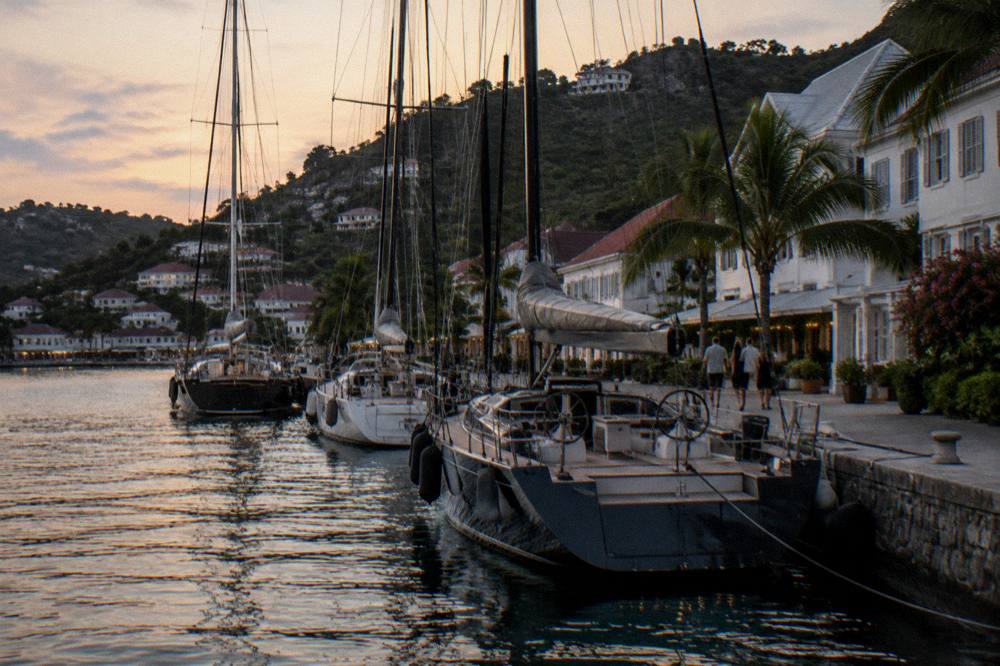
For the water itself, the planning facts are already on this page: the climate table under the sea-state section, the hurricane-season dates, and the group day's summer window. A reasonable synthesis, labelled as synthesis: the group day's May-to-August season sits in warm, moderately wet months with highs around 30.7 to 31.6 C, while a winter charter buys you the driest months and the festival calendar. Whichever you pick, book the crossing first and the rest of the day second, because with only six products on the roster, dates are the scarce resource. Travellers weighing a single day against an overnight can start with whether St Barts is better as a day trip or overnight.
One closing thought in the site's own voice. This guide has deliberately refused the two sentences most snorkeling pages open with: what you will see and how clear the water is. Neither is knowable in advance, and the reserve's own rules, no touching, no taking, no gloves, are the only guaranteed underwater facts. The boats are real, the stops are named, the prices are printed. That is a solid foundation for a decision, and it is what St Barthelemy Tours exists to publish.
Common Questions About Snorkeling In St Barts
Where Can You Snorkel In St Barts?
The stops named on this site's tour listings are Colombier Beach, Ile Fourchue, St Jean Beach and Gustavia. Colombier and Fourchue are boat stops inside the marine reserve; St Jean and Gustavia are the shore-accessible pair. No listing promises sightings or visibility, and sea life is variable by nature.
Can You Snorkel At Colombier Beach From Shore?
Colombier has no road access, only a hiking trail, and the group day tour is the only listing that names it as a stop. The reserve lists it as one of its five zones, with ecological mooring buoys and a 5 knot speed limit in the bay.
What Is The Cheapest Way To Snorkel St Barts By Boat?
The group boat day from Simpson Bay, from $189 per person plus a US$20 government fee, about 7 hours with gear, lunch and drinks listed. It runs 12 May to 31 August 2027 only. Outside that window the options are private charters from $1,947.52 per group upward.
Are Jet Skis Available In St Barts?
No. The marine reserve bans jet skis, seabobs, electric surfboards and any thermal or electric propulsion device in its waters, and no such product exists on any booking platform for the island.
Is Snorkeling In St Barts Allowed Everywhere In The Marine Reserve?
Swimming and snorkeling are broadly compatible with the reserve's simple-protection zones, subject to the published bans: no gloves, no touching turtles or coral, no taking shells or coral, no feeding animals. Reinforced zones add total bans on fishing, anchoring and scuba diving, and the 23 marked dive sites follow stricter buoy rules.
When Is The Best Month For Snorkeling In St Barts?
No visibility or sea-temperature record exists in the official sources, so no month can be promised as clearest. The documented pattern: rainfall is lowest from January to April, heaviest in October, and hurricane season runs 1 June to 30 November with a mid-August to mid-October peak.